Sunday, 31 January 2010

Casio Digital Guitars


I first saw one of these on Flight of the Conchords.

"The Casio DG-20 is a stringed guitar, but every time you play those strings, corresponding MIDI data is sent to the onboard computer, which plays the sounds of whichever instrument you've selected! Naturally the sounds are not mind-blowingly awesome, but some are actually pretty usable. You can either play the DG-20 as a standalone guitar via its built-in speakers, or for better quality sound you can plug it into your stereo."


Guitar Hero/Rock Band et al

People are modifying these controllers to make them more like the electric guitar, here are a few examples:

Telegraph Blog

Link

An article about the influence on Jimi Henxrix's influence on contemporary guitar and dance music.

Line 6 Variax

"Variax® is the one guitar that is a complete collection of guitars. No more dragging around multiple acoustics and electrics to gigs or recording studios. Variax gives you an endless variety of sounds from classic acoustic and electric tones all the way to sitar and banjo, all in one instrument. Moreover, the absence of magnetic pickups means that every note comes out crystal clear without any unwanted pickup noise.

Variax is the only guitar that allows you to plug into a computer and customize your tone or apply alternate tunings to any of the 25 presets. Line 6's exclusive Variax Workbenchsoftware lets you fine-tune all the details of each tone, or change your tuning to Open G, DADGAD, D-MODAL, Drop-D, or any tuning you can imagine, without ever needing a tuner.

For greater control, Variax integrates seamlessly withPOD® XT Live and Vetta™ II - not only powering the guitar but also letting you control the entire signal chain right at your feet."


Chameleon Guitar

Official Website

"The Chameleon Guitar, developed at the MIT Media Lab, presents a unique combination of traditional acoustic values and digital abilities. This is a real hybrid machine; a computer reads acoustic information from a wooden heart (resonator) to create new sound experience. This is an academic research project, and not a commercial one; hopefully it will influence others to explore what lies between our physical world and computers.

Today’s musical instruments fall into three very distinct classes, each with its own benefits and drawbacks. Traditional acoustic instruments offer richness and uniqueness of qualities that result from the unique properties of the physical materials of which they are made. The hand crafted construction qualities are very important here. Electric guitars are highly expressive tools that relay on their structure and materials. In contrast, computer based instruments lack this richness, uniqueness and expressivity; they produce very predictable and generic results, but offer the advantage of flexibility: they can be many instruments in one. The Chameleon Guitarpresents a new approach of designing and building instruments, which attempts to combine the best of all. The approach is characterized by sampling the resonator's physical matter and its acoustic properties and complemented by a physically simulated, a virtual shape or other digital effects. This approach to building digital objects maintains some of the rich qualities and variation found in real instruments (the result of natural materials combined with hand crafted elements) with the flexibility and open-endedness of digital ones."

Gibson Robot Guitar


Official

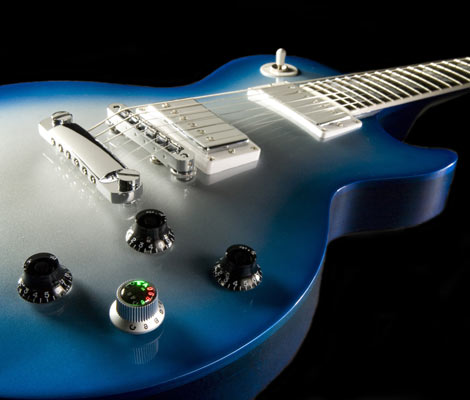
"True to the spirit of innovation that inspired Gibson to invent the legendary Tune-o-matic bridge, the powerful humbucker, and the revolutionary Digital Les Paul, Gibson proudly presents the Gibson Robot Guitar—the world's first guitar with robotic technology.

Since the dawn of the instrument, musicians have come to accept the guitar's imperfections and lack of tonal precision as necessary evils. Onstage and off, guitarists have fought to stay in tune. Every music lover and performer has had to suffer through the show—halting, mood-killing atonal droning of a loudly amped guitar being brought into tune. And in the studio, or at home, imprecise intonation throws the guitar in and out of tune, up and down the neck, as the instrument requires tweaking with each season and at times with each string change.

For as long as the guitar has existed, guitar lovers have had two choices—live with a temperamental and out-of-tune instrument or make frequent trips to the shop for setups. Not anymore."

Essentially just re-tunes your guitar for you. People seem to love it though, look at the average customer results on Harmony-Central:


Misa Digital Guitar